Religion is not the wishful thinking of a human being, but the faith of those who believe in one Almighty. All religions are corrupted if taken to the extremes including Judaism, Christianity, Islam, Buddhism, Hinduism, etc. All, because of human-frailty factors and the tendency to force one's beliefs to another which then divide us. If we can all devote our lives to the Truth, God alone, we can all live in peace and harmony....Amor Patriae
RELIGION
Wednesday, June 8, 2022
A NEW PLATFORM FOR THE NEXT WAR
On March 9, 1862, the Union warship Monitormet its Confederate counterpart, Virginia. After a four-hour exchange of fire, the two fought to a draw. It was the first battle of ironclads. In one day, every wooden ship of the line of every naval power became immediately obsolete.
On December 7, 1941, the Japanese bombed Pearl Harbor. If the battle of the ironclads settled once and for all the wood-versus-iron debate, Japanese carrier-based aircraft settled the battleship-versus-carrier debate by sinking the cream of America’s battleship fleet in a single morning.
On April 14, 2022, the Ukrainians sank the Russian cruiser Moskva with a pair of Neptune anti-ship missiles. And that success posed an urgent question to the world’s major militaries: Has another age of warfare just begun? After 20 years spent fighting the post-9/11 wars, the United States military’s attention is again focused on a peer-level adversary. The Pentagon hasn’t been thinking this way since the Cold War, and it is attempting a profound transformation. Today, fierce debate attends this transformation, and nowhere more acutely than in the Marine Corps.
In March 2020, the Marine commandant, General David Berger, published “Force Design 2030.” This controversial paper announced a significant restructuring based on the belief that “the Marine Corps is not organized, trained, equipped or postured to meet the demands of the rapidly evolving future operating environment.” That “future operating environment” is an imagined war with China in the South Pacific—but in many ways, that hypothetical conflict resembles the real war in Ukraine.
The military we have—an army built around tanks, a navy built around ships, and an air force built around planes, all of which are technologically advanced and astronomically expensive—is platform-centric. So far, in Ukraine, the signature land weapon hasn’t been a tank but an anti-tank missile: the Javelin. The signature air weapon hasn’t been an aircraft, but an anti-air missile: the Stinger. And as the sinking of the Moskvashowed, the signature maritime weapon hasn’t been a ship but an anti-ship missile: the Neptune.
Berger believes a new age of war is upon us. In “Force Design 2030,” he puts the following sentence in bold: “We must acknowledge the impacts of proliferated precision long-range fires, mines, and other smart weapons, and seek innovative ways to overcome these threat capabilities.” The weapons General Berger refers to include the same family of anti-platform weapons Ukrainians are using to incinerate Russian tanks, shoot down Russian helicopters, and sink Russian warships. The successes against a platform-centric Russian Goliath by an anti-platform-centric Ukrainian David have elicited cheers in the West, but what we are witnessing in Ukraine may well be a prelude to the besting of our own American Goliath.
The flying ship is a ground effect vehicle (GEV) a vehicle that is designed to attain sustained flight over a level surface (usually over the sea), by making use of ground effect, the aerodynamic interaction between the wings and the surface. Among the best known are the Soviet ekranoplans, but names like wing-in-ground-effect (WIG), flarecraft, sea skimmer, or wing-in-surface-effect ship (WISE) are also used.
Later in the very near future..............
Carbon fibre planes: Lighter and stronger by design
Currently, Boeing's latest plane, the 787 Dreamliner uses composites for half of its airframe including the fuselage and wing, while Airbus's A350 XWB has both its fuselage and wings made of carbon fibre.
While the use of carbon fibre has allowed the creation of sweeping wing tips, which can cut fuel consumption by up to 5%, both aircraft are still fairly conventionally shaped.
Yet, the great advantage of using carbon fibre as opposed to traditional metal is that it gives designers much more freedom when trying to juggle the conflicting demands of aerodynamic efficiency, fuel savings and reducing engine noise.
So, the airliners of the future are likely to be radically different.
Such shapes could include blended wing designs, where the fuselage and wings merge into each other - like some military aircraft today.
Similar shape BWB plane burns 20 per cent less fuel than conventional aircraft and can carry more than 300 passengers
'Flying-V' was developed by the Delft Technical University in the Netherlands and KLM is funding the design
It has the same wingspan as existing planes and is named after the iconic Gibson Flying-V electric guitar
The aircraft would be able to carry up to 314 passengers in the V-shaped layout of the craft its designers claim
Passenger cabin, cargo hold and fuel tanks to be integrated in the design which uses 20 per cent less fuel
Dutch airline KLM are funding a pioneering aeronautical project which could see the shape and layout of commercial aeroplanes changed forever.
The stunning 'Flying-V' design, financially backed by KLM, has the same wingspan as existing planes and is able to carry up to 314 passengers.
It is named after the iconic Gibson Flying-V electric guitar used by a number of legendary players - from Eddie Van Halen and Jimi Hendrix, to Brian May and Keith Richards.
The concept craft, developed by researchers at Delft Technology University in the Netherlands, flares diagonally backwards from it nose to create the striking V-shape.
Its designers say this unique configuration uses 20 per cent less fuel. The wings would host the passenger space, cargo hold, fuel tanks and all other infrastructure, it is believed.
A stunning 'V-shaped' craft developed by researchers at Delft Technology University in the Netherlands has been financially backed by KLM
It has the wingspan of existing planes but is shaped like a guitar, with the nose flaring backwards diagonally to create the striking V-shape. It is believed to use 20 per cent less fuel, be more aerodynamic and still be able to carry up to 314 passengers.
The aircraft name is derived from the moniker of the electric guitar developed by Gibson in 1958.
Designs were drawn up by Delft Technology University in the Netherlands.
KLM, the Dutch aeronautical giant, is funding the development of the unique plane.
It has the wingspan of existing planes but is shaped like a guitar, with the nose flaring backwards diagonally to create the striking V-shape.
Its total width is 215ft (65m) and its length will be slightly shorter, at 180 ft (55m).
Its size makes it a comparable rival to the traditional Airbus A350 and the Boeing 787. pair of turbofan jet engines will be mounted at its rear and the design would drastically reduce both the carbon footprint of air travel and the expenditure on fuel.Pieter Elbers, the KLM chief executive, refused to reveal the exact extent of the project but it is being heralded as a potential leader in the field of 'sustainable aviation initiatives'. Its size makes it a comparable rival to the traditional Airbus A350 and the Boeing 787 and it would be able to use existing gates, hangars and runways. Its total width is 215ft (65m) and its length will be slightly shorter, at 180 ft (55m).
WHAT IS THE 'FLYING-V'?
Details of what the inside will look like are scarce but it will inevitably allow for a range of innovative seating arrangements, rooms and fittings.
The wings would host the passenger space, cargo hold, fuel tanks and all other infrastructure, it is believed
Its total width is 215ft (65m) and its length will be slightly shorter, at 180 ft (55m). Details of what the inside will look like are scarcebut it will inevitably allow for a range of innovative seating arrangements, rooms and fittings
Lightweight furniture will enable the plane to maximise its gains in fuel efficiency.
Professor Henri Werij, dean of the university's faculty of aerospace engineering, said the object was to make aviation more sustainable, according to The Times.
'New and energy-efficient aircraft designs such as the Flying-V are important, as are new forms of propulsion. Our ultimate aim is emission-free flight,' he said.
The aircraft name is derived from the moniker of the electric guitar developed by Gibson in 1958.
Lightweight furniture will enable the plane to maximise its gains in fuel efficiency. Professor Henri Werij, dean of the university's faculty of aerospace engineering, said the object was to make aviation more sustainable, according to The Times
Like its Russian counterpart, the American military has long been built around platforms. To pivot away from a platform-centric view of warfare is both a cultural challenge—what does it mean to be a fighter pilot without a jet, a tanker without a tank, or a sailor without a ship?—and a resource challenge. It asks the U.S. military, as well as the U.S. defense industry, to divest itself of legacy capabilities like, for example, a $13 billion Ford-class aircraft carrier, in order to invest in new, potentially less profitable technologies like, say, $6,000 Switchblade drones that can kill tanks.
disunity among senior commanders. One of the dissenters is a former commandant, retired General Charles Krulak. “You’re divesting yourself of huge capability to buy capability that’s still on the drawing boards,” Krulak told me. “We’re being painted as a bunch of old farts who want the Marine Corps to remain as it was and don’t understand the impact of technology on warfare. Nothing could be further from the truth.”
To discount Krulak’s views would be a mistake. His tenure as commandant ushered in significant innovations for the Corps. He laid the intellectual groundwork that allowed the Corps to fight in the post-9/11 world. He also acquired the V-22 for the Marine Corps, a first-of-its-kind tilt-rotor aircraft that is both a plane and a helicopter. Berger’s strategic vision is also the first of its kind; in the event of a war with China, it imagines a 21st-century island-hopping campaign in which bands of 60 to 70 highly trained, lethally equipped Marines would infiltrate onto islands in the South Pacific to target the Chinese navy with advanced missile systems and other long-range weapons. The war at sea, in Berger’s vision, would be decided by a slew of Moskva-like engagements.
Berger’s critics don’t buy it. “The assumption that Marines can get on contested islands without being detected and conduct resupply missions is unrealistic,” Krulak said. “Plus, you’re underestimating the capability of the Chinese. The belief that these forces will shoot and scoot counts on Marines moving faster than a Chinese missile flies. You’re going to lose Marines and be unable to evacuate our wounded and dead. The Navy won’t sail in to get our wounded.”
Admiral James Stavridis, who spent much of his 40-plus-year Navy career in the South China Sea, is a believer in Berger’s vision. “The Army of tomorrow will look like the Marine Corps of today,” Stavridis told me. “What General Berger is doing is critical.” A truism among Marines is that the Corps must be at its most ready when America is at its least. In the 1930s, the Marine Corps pioneered the amphibious doctrine that would pave the way not only for the island-hopping campaigns in the Pacific but also the amphibious landings that allowed the Army to liberate Europe. Innovation, according to Stavridis, remains a core Marine mission.
The debate in the Marine Corps is more profound than the internecine politics of one service branch; it’s a debate about which form of warfare will dominate in the next decades of the 21st century, a platform-centric one or an anti-platform-centric one. Historical precedent abounds for these types of debates. Before the First World War, in the opening years of the 20th century, many militaries adhered to the cult of the offense, a then-stale belief that well-trained, determined troops would always carry the day over a defending force. In the Napoleonic Wars 100 years before, this had often proved true. But up against the 20th century’s breech-loading rifles and machine guns, the offense had become the weaker form of warfare. Tragically, it took the Marne, the Somme, and countless other bayonet charges into the teeth of chattering machine guns for the generals of that era to accept that their understanding of warfare was dated.
Representative Seth Moulton, a former Marine and Iraq War veteran who sits on the House Armed Services Committee, believes that today’s dissenting generals are failing to comprehend how much technology is changing the battlefield and how quickly the services must adapt. “When you look at what weapons are on top of the Ukrainians’ wish list,” Moulton told me, “it isn’t towed howitzers. Top of their list are armed drones, anti-tank missiles, and anti-ship missiles.”
But what if Berger is wrong? What if his “divest to invest” strategy winds up overinvesting the Marine Corps in a highly specific vision of warfare that never comes to pass? According to Moulton, much of this comes down to the role the Marine Corps has traditionally played as an incubator for new ideas as the smallest, nimblest of the services. “Our country can afford to have the Marine Corps overinvested in a new type of warfare that never comes to pass,” Moulton explained. “What our country cannot afford is to have the Marine Corps underinvested in a new type of warfare that does come to pass.”Events in Ukraine seem to validate Berger’s anti-platform-centric view of warfare, in much the same way that World War I validated those who had argued that defense had become stronger than offense. Of course, no form of warfare maintains primacy forever. Krulak made this point as we finished our conversation. “We need to be careful we don’t learn the wrong lessons from Ukraine. You have a great measure. The next thing you know they come up with a countermeasure. So you come up with a counter-countermeasure.”One of the most famous countermeasures developed after the end of the First World War was France’s Maginot Line, a physical shrine to the primacy of defense. What the French failed to account for was that in two short decades, certain developments—more advanced tanks, aircraft, and combined-arms doctrine—had once again swung the balance, allowing offense to reassume its role as the dominant form of warfare. The result was a German blitzkriegin June 1940 that simply maneuvered around the Maginot Line.
The wager that Berger and the Marine Corps are making is that anti-platform systems won’t be an American Maginot Line, but the best way to save a generation of Americans from their own Somme or Moskva.
In the twilight of age all things seem strange and phantasmal,
As between daylight and dark ghost-like the landscape My heart goes back to wander there,
And among the dreams of the days that were,
I find my lost youth again.
And the strange and beautiful song,
The groves are repeating it still:
"A boy's will is the wind's will,
And the thoughts of youth are long, long thoughts."
I should not be withheld but that some day
into their vastness I should steal away,
Fearless of ever finding open land,
or highway where the slow wheel pours the sand...RF
On the road of life one mile-stone more!
In the book of life one leaf turned o'er!
Like a red seal is the setting sun
On the good and the evil men have done,--
Naught can to-day restore!
Life is real! Life is earnest!
And the grave is not its goal;
Dust thou art, to dust returnest,
Was not spoken of the soul.
Not enjoyment, and not sorrow,
Is our destined end or way;
But to act, that each to-morrow
Find us farther than to-day.
Art is long, and Time is fleeting,
And our hearts, though stout and brave,
Still, like muffled drums, are beating
Funeral marches to the grave.
In the world's broad field of battle,
In the bivouac of Life,
Be not like dumb, driven cattle!
Be a hero in the strife!
Trust no Future, howe'er pleasant!
Let the dead Past bury its dead!
Act,--act in the living Present!
Heart within, and God o'erhead!
Lives of great men all remind us
We can make our lives sublime,
And, departing, leave behind us
Footprints on the sands of time;
Footprints, that perhaps another,
Sailing o'er life's solemn main,
A forlorn and shipwrecked brother,
Seeing, shall take heart again.
Let us, then, be up and doing,
With a heart for any fate;
Still achieving, still pursuing,
Learn to labor and to wait...
Monday, January 24, 2022
This is "Where the soul meets the body"
Lord Combermeres Ghost
The following photograph was taken in Combermere Abbey Library in 1891. If you look closely, the figure of a man can be seen in the chair in the photo. It is believed to be the ghost of Lord Combermere. Combermere died after being hit by a horse drawn carriage. At the time the photo was taken, Lord Combermere's funeral was taking place only a few miles away.
Ghost Monk of Newby Church
This photo was shot in 1963 by Reverend Lord in Newby Church, Yorkshire, England. A shrouded face upon a body can be seen gazing right into the camera. Even stranger, Lord claims there was nothing visible to the naked eye immediately prior to shooting the photo. Could this be the ghost of a monk that now haunts the church?
The Brown Lady of Raynham Hall
This photograph was taken in Raynham Hall in Norfolk, England in 1936. It is widely regarded as one of the most captivating ghost sightings ever caught on camera.
The story starts in the 1700's when Charles Townshend suspected his wife Dorothy of being unfaithful in their marriage. Legal records indicate that Dorothy died and was buried in 1726, but it is widely believed that Charles faked her death and held her captive in a remote area of their home until her actual death decades later.
To this day, Dorothy's ghost, referred to as The Brown Lady, is believed to haunt the staircase at Raynham Hall. This photograph is merely one of the many sightings of Dorothy's spirit in the home since her death.
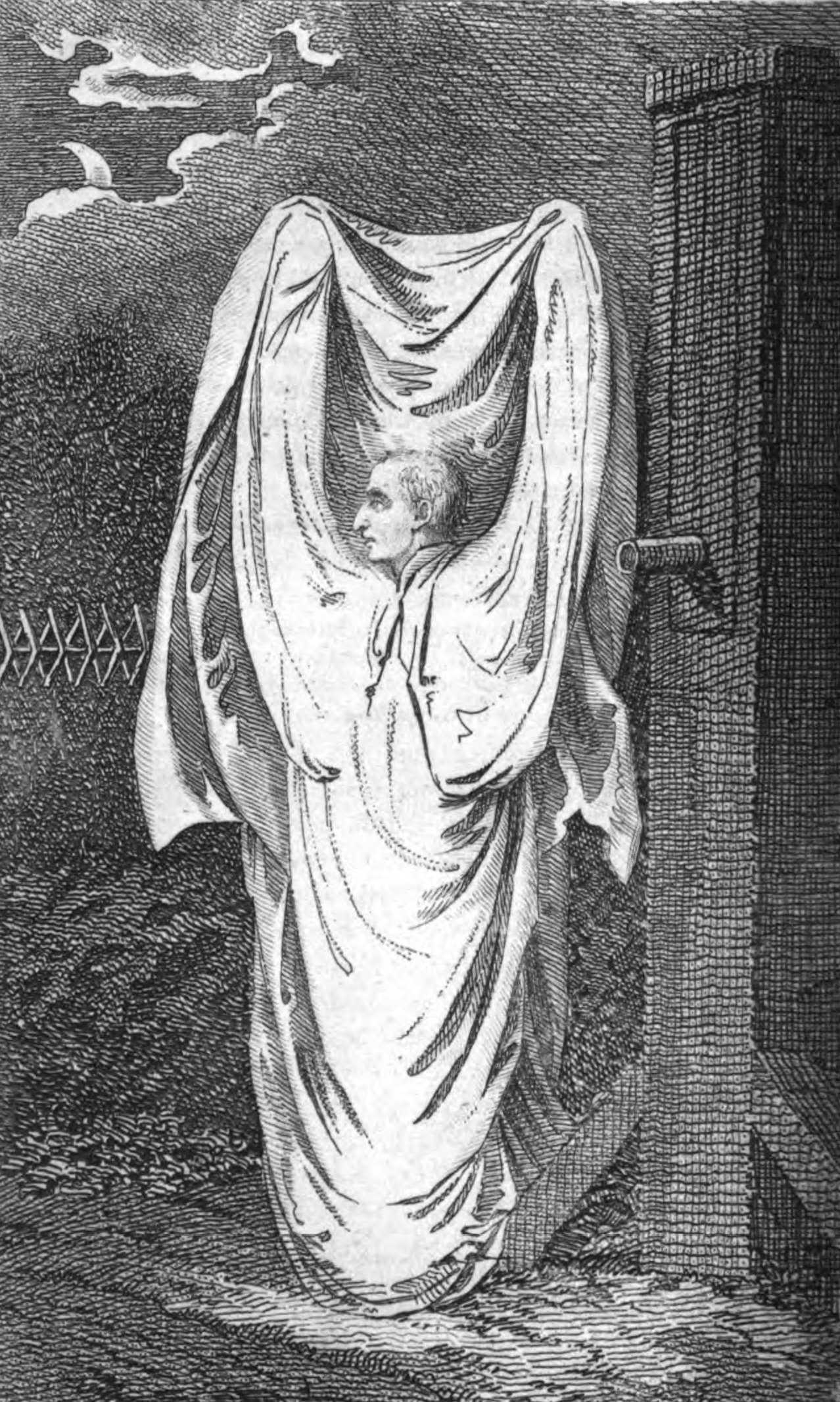
Engraving of the Hammersmith Ghost inKirby's Wonderful and Scientific Museum, a magazine published in 1804
In traditional belief and fiction, a ghost is the soul or spirit of a deceased person or animal that can appear, in visible form or other manifestation, to the living. Descriptions of the apparition of ghosts vary widely from an invisible presence to translucent or barely visible wispy shapes, to realistic, lifelike visions. The deliberate attempt to contact the spirit of a deceased person is known as necromancy, or in spiritism as a séance.
The belief in manifestations of the spirits of the dead is widespread, dating back to animism or ancestor worship in pre-literate cultures. Certain religious practices—funeral rites, exorcisms, and some practices of spiritualism and ritual magic—are specifically designed to appease the spirits of the dead. Ghosts are generally described as solitary essences that haunt particular locations, objects, or people they were associated with in life, though stories of phantom armies, ghost trains,phantom ships, and even ghost animals have also been recounted.
The English word ghost continues Old Englishgást, from a hypothetical Common Germanic*gaistaz. It is common to West Germanic, but lacking in North and East Germanic (the equivalent word in Gothic is ahma, Old Norse has andi m., önd f.). The pre-Germanic form was *ghoisdo-s, apparently from a root denoting "fury, anger" reflected in Old Norse geisa "to rage". The Germanic word is recorded as masculine only, but likely continues a neuter s-stem. The original meaning of the Germanic word would thus have been an animating principle of the mind, in particular capable of excitation and fury (compare óðr). In Germanic paganism, "Germanic Mercury", and the later Odin, was at the same time the conductor of the dead and the "lord of fury" leading the Wild Hunt.
Besides denoting the human spirit or soul, both of the living and the deceased, the Old English word is used as a synonym of Latin spiritus also in the meaning of "breath" or "blast" from the earliest attestations (9th century). It could also denote any good or evil spirit, i.e. angels and demons; the Anglo-Saxon gospel refers to the demonic possession of Matthew 12:43 as se unclæna gast. Also from the Old English period, the word could denote the spirit of God, viz. the "Holy Ghost". The now prevailing sense of "the soul of a deceased person, spoken of as appearing in a visible form" only emerges in Middle English (14th century). The modern noun does, however, retain a wider field of application, extending on one hand to "soul", "spirit", "vital principle", "mind" or "psyche", the seat of feeling, thought and moral judgement; on the other hand used figuratively of any shadowy outline, fuzzy or unsubstantial image, in optics, photography and cinematography especially a flare, secondary image or spurious signal.[4]
The synonym spook is a Dutch loanword, akin to Low Germanspôk (of uncertain etymology); it entered the English language via the United States in the 19th century.[5][6][7][8] Alternative words in modern usage include spectre (from Latin spectrum), the Scottish wraith (of obscure origin), phantom (via French ultimately from Greekphantasma, compare fantasy) and apparition. The term shade in classical mythology translates Greek σκιά,[9] or Latin umbra,[10] in reference to the notion of spirits in theGreek underworld. "Haint" is a synonym for ghost used in regional English of the southern United States,[11] and the "haint tale" is a common feature of southern oral and literary tradition.[12] The term poltergeist is a German word, literally a "noisy ghost", for a spirit said to manifest itself by invisibly moving and influencing objects.[13]
Wraith is a Scots word for "ghost", "spectre" or "apparition". It came to be used in Scottish Romanticist literature, and acquired the more general or figurative sense of "portent" or "omen". In 18th- to 19th-century Scottish literature, it was also applied to aquatic spirits. The word has no commonly accepted etymology; the OED notes "of obscure origin" only. An association with the verb writhe was the etymology favored by J. R. R. Tolkien.[14] Tolkien's use of the word in the naming of the creatures known as the Ringwraiths has influenced later usage in fantasy literature. Bogey[15] or bogy/bogie is a term for a ghost, and appears in Scottish poet John Mayne's Hallowe'en in 1780.[16][17]
A revenant is a deceased person returning from the dead to haunt the living, either as a disembodied ghost or alternatively as an animated ("undead") corpse. Also related is the concept of a fetch, the visible ghost or spirit of a person yet alive.
A notion of the transcendent, supernatural or numinous, usually involving entities like ghosts, demons or deities, is a cultural universal.[18] In pre-literate folk religions, these beliefs are often summarized under animism and ancestor worship. In many cultures malignant, restless ghosts are distinguished from the more benign spirits involved in ancestor worship. Ancestor worship typically involves rites intended to prevent revenants, vengeful spirits of the dead, imagined as starving and envious of the living. Strategies for preventing revenants may either include sacrifice, i.e., giving the dead food and drink to pacify them, or magical banishment of the deceased to force them not to return. Ritual feeding of the dead is performed in traditions like the Chinese Ghost Festival or the Western All Souls' Day. Magical banishment of the dead is present in many of the world's burial customs. The bodies found in many tumuli (kurgan) had been ritually bound before burial,[21] and the custom of binding the dead persists, for example, in rural Anatolia.[22]
Although the human soul was sometimes symbolically or literally depicted in ancient cultures as a bird or other animal, it appears to have been widely held that the soul was an exact reproduction of the body in every feature, even down to clothing the person wore. This is depicted in artwork from various ancient cultures, including such works as theEgyptian Book of the Dead, which shows deceased people in the afterlife appearing much as they did before death, including the style of dress.
While deceased ancestors are universally regarded as venerable, and often imagined as having a continued presence in some sort ofafterlife, the spirit of a deceased person which remains present in the material world (viz. a ghost) is regarded as an unnatural or undesirable state of affairs and the idea of ghosts or revenants is associated with a reaction of fear. This is universally the case in pre-modern folk cultures, but fear of ghost also remains an integral aspect of the modern ghost story, Gothic horror and other horror fictiondealing with the supernatural.
Another widespread belief concerning ghosts is that they are composed of a misty, airy, or subtle material. Anthropologists link this idea to early beliefs that ghosts were the person within the person (the person's spirit), most noticeable in ancient cultures as a person's breath, which upon exhaling in colder climates appears visibly as a white mist.[19] This belief may have also fostered the metaphorical meaning of "breath" in certain languages, such as the Latinspiritus and the Greekpneuma, which by analogy became extended to mean the soul. In the Bible, God is depicted as animating Adam with a breath.
In many traditional accounts, ghosts were often thought to be deceased people looking for vengeance, or imprisoned on earth for bad things they did during life. The appearance of a ghost has often been regarded as an omen or portent of death. Seeing one's own ghostly double or "fetch" is a related omen of death.[24]
White ladies were reported to appear in many rural areas, and supposed to have died tragically or suffered trauma in life. White Lady legends are found around the world. Common to many of them is the theme of losing or being betrayed by a husband or fiancé. They are often associated with an individual family line or regarded as a harbinger of death similar to a banshee.
Legends of ghost ships have existed since the 18th century; most notable of these is the Flying Dutchman. This theme has been used in literature in The Rime of the Ancient Mariner by Coleridge.
A grandmother was left astonished after a photo posted on Facebook from her granddaughter’s christening appeared to show the ghost of her late husband. When Heather Sewell, 50, first saw the picture she immediately spotted the apparition, bearing a striking resemblance to her late husband Terry. The black and white face can be seen above the church font hovering over baby Mia-Bella Kennett and the rest of the family.
Familiar face: The photograph taken at St.Martin's Church in Canterbury was posted on Facebook. Only later did grandmother Heather Sewell notice the face, circled, bearing a striking resemblance to her late husband Terry. The bizarre image was caught on camera at St Martin’s Church, Canterbury, Kent by Mrs Sewell's son Jamie, 29, on his mobile phone. It was only when the grandmother-of-two was looking through the photos online later that she spotted the familiar face beside the family.
Outline: Mrs Sewell said she was shocked when she noticed the face in the picture taken during her granddaughter's christening. Mrs Sewell, from Petham, Kent, said she could not believe the likeness to her late husband. Terry Sewell, who worked as a labourer, died 17 years ago after committing suicide aged 41. Mrs Sewell, who works as a taxi driver, said it was 'upsetting' to see her husband's face. She said: ' I tried to convince myself that it was not Terry - but it is so convincing that I believe it is.
'Terry had a long face and so does the ghost and it has the same hair style as Terry had. 'The ghost is also the same height as Terry was - about 5ft 8in. 'I am quite a superstitious person, but I am not over-the-top. 'I do believe there is something out there - there are too many things in the world we cannot explain.'
She added: 'I was so shocked when I saw it, as we all were.
'It looks very much like Terry. I know there has been no photo trickery so it is all very spooky and perhaps not what you want to see at a christening.
'I was in the pub afterwards when I first saw the Facebook page and everyone was stunned because it’s so clear.'
St Martin’s is the oldest church in the country that is still in use for religious services, but a ghostly encounter has never been reported previously at the church.
Heather's daughter Gemma Sewell, 27, and her partner Jamie were joined by their older daughter Jaiden, 5, and two sets of godparents for Mia-Bella Kennett's Christening.
This from my own experience. Orbs appeared in the photos from an unknown tombstone located at the back of my property circa early 20th century.
The Pink Lady of Greencastle, Indiana, was discovered by ghost hunter Guy Winters when he went with a friend to photograph the woman who haunts the O'Hare Mansion
This photograph was taken during the American Civil War. A ghost, believed to be that of a dead soldier, was captured walking up these stairs in a basement. But not all ghosts have been scorned.
An Australian woman named Mrs Andrews was visiting the grave of her daughter in a cemetery in Queensland, in the 1940s when she took a photo. Her daughter Joyce had died the year before at the age of 17. She was shocked to find a child in the photo that she did not recognise sitting on top of the grave. Australian paranormal researcher Tony Healy visited the cemetery in the late 1990s to find out what had happened. He found that near Joyce's grave, two infant girls were buried.
Diane and Peter Berthelot visited Worstead Church in Norfolk in 1975. Peter snapped a photo of his wife praying silently in the pew. They didn't realise until later that she was not alone
THE SCIENCE OF GHOSTS
Researchers have studied many photographs of ghosts, and believe the majority can be explained as a trick of the light, or a technical issue with the camera.
Recently, Professor Richard Wiseman carried out an experiment to try to explain ghost pictures.
He concluded that most were down to shadows or, in some cases, double exposures on a camera.
University College London researchers also found that when we gaze around in a poorly lit room, it can sometimes fool our brains into seeing things that are not really there.
The same could be true for photographs, effectively 'tricking' the brain. Diane and Peter Berthelot visited Worstead Church in Norfolk in 1975 with their 12-year-old son. Peter snapped a photo of his wife praying silently in the pew. When they looked at the photos a few months later, a friend asked 'Who's that sitting behind you, Di?' The mysterious figure appeared to be dressed in old-fashioned clothing, including a bonnet, according to About.com. Confused and confounded, the couple returned to the church the next year to share their photograph. The church vicar, Reverend Pettit, told the Berthelots the legend of the White Lady. The ghost, Reverend Pettit said, was known to visit people who had fallen ill, offering them comfort and healing them. Diane was shocked because when the photo was taken, she was taking antibiotics and was not doing well. The legends of the White Lady date back more than 100 years. She is said to appear on Christmas Eve every year and the church in which she once dwelled is now an aptly named pub: The White Lady.
Robert A. Ferguson, author of Psychic Telemetry, was speaking in Los Angeles, California, on November 16, 1968. He believed his brother Walter, who died in 1944 during World War II, was standing beside him. Robert A. Ferguson, a spiritualist and the author of Psychic Telemetry: New Key to Health, Wealth, And Perfect Living, was speaking in Los Angeles, California, on November 16, 1968 when the photo above was taken. He believed his brother Walter, who died in 1944 during World War II, was standing beside him during the speech and he just may be right. Apparently, this photograph was taken with a Polaroid camera, making a double exposure hypothesis very unlikely. Many ghost hunters even argue that the ears on the apparition and the man are vastly different, proving they are not the same man
Mrs Andrews took this picture while visiting her daughter's grave in Queensland, Australia in the 1940s. Her child Joyce had died the year before aged 17. She was shocked to find a young stranger sitting on the grave. When paranormal researcher Tony Healy visited the cemetery in the 1990s, he found that near Joyce's grave, two infant girls were buried
In 1924, the SS Watertown was en route to the Panama Canal from New York City when James Courtney and Michael Meehan were killed by gas fumes in a freak accident while cleaning a cargo tank. Soon after, crew members saw two faces in the water following the ship. Some of the photographs have been researched for decades, with paranormal aficionados looking into their origins. In 1924, for example, the SS Watertown was en route to the Panama Canal from New York City. James Courtney and Michael Meehan were killed by gas fumes in a freak accident while cleaning a cargo tank. In the days following their deaths, crew members began reporting seeing two faces in the water following the ship. The captain snapped several photographs of the water where their faces appeared and of five, one appeared to contain the apparitions.
This photograph was taken hours before this dying man's last breath. Three mysterious orbs appeared in the images, which some believe to be spirits and others swear are fingerprint smudges. Blake Smith looked into the history of the image after it frightened him in elementary school. He says the story originated with the oil company Cities Service (CITGO) who were the owners of the Watertown. The first publication of the image was in the in-house magazine Service in 1934, Mr Black says. He found another paranormal investigator's research, which included information about how the captain's film was developed. A commercial photographer in New York apparently took hold of the film once the ship docked. Mr Blake consulted Joe Nickell, investigator with the Centre for Inquiry about his opinion.
Two men are seen working on renovations for this old and 'empty' hospital in 1918 - but on the far left balcony, they're not alone. 'That picture has a suspiciously hard edge to the (viewer’s) left side of the face on the left, and this ruler-straight line (the edge of a rope) extends all the way to the top of the (cropped) picture. This looks like some form of photographic skulduggery (indicative of cutting and pasting, or possibly masking in conjunction with an airbrush).' Despite his findings, he believes that one of the ghost faces may be real, the second added for effect.
My thousand years old house in France. The forty feet high wall at the back of the house was the old city wall, a part of the medieval citadel of an ancient city established by King Richard the Lionheart of England.
A THOUSAND YEARS OLD FRENCH HOME ON OUR 44th YEAR The house was a part of a Medieval Fortress established during the time of King Richard the Lion heart of England. After Henry II fell seriously ill in 1170, he put in place his plan to divide his kingdom, although he would retain overall authority over his sons and their territories. In 1171 Richard left for Aquitaine with his mother, and Henry II gave him the duchy of Aquitaine at the request of Eleanor. Richard and his mother embarked on a tour of Aquitaine in 1171 in an attempt to pacify the locals around the area of Montaigut Together they laid the foundation stone of St Augustine's Monastery in Limoges. In June 1172 Richard was formally recognized as the Duke of Aquitaine when he was granted the lance and banner emblems of his office; the ceremony took place in Poitiers and was repeated in Limoges, where he wore the ring of St Valerie, who was the personification of Aquitaine. In the south entree near the house, you can see a proclamation of the visit that was brought by Eleonore d'Aquitaine her son Richard the Lionheart, then Count of Poitiers. Upon the death of her husband Henry II on 6 July 1189, Richard I was the undisputed heir.
Above the attic of my house in France haunted by orbs. It does seem that there is a conscious mind behind the orbs. By looking more closely into the spirit orbs sometimes there does appear to be faces. The paranormal spirit orb photograph was taken at the funeral service of my father and it clearly shows a white spirit orb in the centre of the room. To the right is a paranormal photograph which shows a close up of the spirit orb. The face inside the spirit orb is quite obvious of my father.Enlarged, magnified orb with the likeness of my father.
Is this the proof that spirits DO exist? At first, it seemed no more than a curious coincidence. Professor Klaus Heinemann, a researcher for NASA, the U.S. space agency, was studying a collection of photographs his wife had taken at a gathering of spiritual healers when he noticed that many of them featured the same pale but clearly defined circle of light, like a miniature moon, hovering above some of the subjects.Like most rational people, he assumed that the pictures were faulty. 'I presumed the circles were due to dust particles, flash anomalies,
An orb is a solid water particles and so on,' says Prof Heinemann.
After-thought: An orb appeared on this photo taken by Klaus Heinemann 'But I was sufficiently intrigued that I returned to the room in which the pictures were taken, in the hope of finding an explanation - like a mirror in the background. None was forthcoming.' Nor could he find any faults with his wife's camera. And as a scientist with considerable experience in sophisticated microscope techniques - examining matter down to atomic levels of optical resolution - his methods were nothing if not rigorous.
Still puzzled, Heinemann set out to discover what else might have caused the mysterious circles. He and his wife began taking hundreds of digital photographs at random events to see whether they could recreate the mysterious effect.
The answer was that they could make these shimmering 'orbs' appear again, but only - absurd as it may sound - if they 'asked' the apparitions to make themselves visible to the camera. And they found this method worked particularly well when the couple photographed spiritual gatherings.
What on earth was going on? Again, a maverick technical glitch seemed the obvious answer. Such anomalies happen frequently in digital photography. If you accidentally jog a camera while a picture is being taken, especially in dim light, you can easily get a double image.
But again, Prof Heinemann ruled out a technical fault. 'We were quickly able to eliminate the common problems associated with photography - such as dust particles, water droplets, reflections and a host of other likely causes.'
Yet the orbs still kept appearing. And the more images he took, the more he was able to study the bizarre properties of these shimmering lights. Heinemann set up dozens of experiments using two cameras on static tripods under controlled conditions. His early experiments found that orbs can move very fast, up to 500mph or more.
Heinemann also found that during his numerous dual camera experiments, when he used twin cameras to capture an object from two different angles, a single orb shape would often appear - but only in one of the two images taken simultaneously.
It was as if the orbs somehow chose which camera to appear on, or whether to appear at all. Eventually, Heinemann was left with only one conclusion: that he was witnessing some form of paranormal intelligence.
'There is no doubt in my mind that the orbs may well be one of the most significant "outside of this reality" phenomena mankind has ever witnessed,' says Professor Heinemann. 'Until now, there has been a huge amount of anecdotal evidence that the spirit world exists. I believe it's no longer anecdotal. Thanks to digital technology, we can see it for the first time. We are dealing with a non-physical - albeit real - phenomenon.'
The temptation, of course, is to dismiss such claims as bunkum. Indeed, many of Professor Heinemann's colleagues consider his research to be 'utter flaky nonsense'.
And yet a growing number of respectable scientists refuse to write off the possibility that these orbs, which are starting to appear on cameras around the world, just might offer a fascinating glimpse into the unknown.
Earlier this year, the world's first conference on orbs took place in Sedona, Arizona, where several scientists controversially stated that they believed orbs were indeed a genuine paranormal phenomenon.
Their conclusions, if correct, could have huge implications on the way we view the universe and our part in it. The experts say that just because something has not yet been scientifically proven, it doesn't mean that it is not real.
Professor William Tiller, a theoretical physicist who spent 35 years researching consciousness and matter at Stanford University in California, reminded the conference that what we see with our physical eyes comprises less then 10 per cent of the known universe.
This is because human vision operates only within a limited range of the electromagnetic spectrum. For instance, we cannot see radio waves, which carry huge amounts of information, yet we know they exist.
Similarly, Miceal Ledwith, a former professor of Theology, who for ten years was President of Maynooth College at the National University of Ireland, reminded the sceptics that when, in 1861, Dr Ignaz Semmelweis had claimed there might be some unseen link between surgeons who didn't wash their hands and the high rate of infection in childbirth, his mainstream colleagues ridiculed him.
Yet he had found the first evidence of what was later to become known as bacteria.
'Most great discoveries throughout history have been initially ridiculed,' Ledwith told the orbs conference. 'To my mind, there is no doubt that the orb phenomenon is real and deserves to be taken seriously. There are not just a few pictures of orbs, which could easily be faked, but hundreds of thousands from all over the world.'
To date, Ledwith, who was also a member of the International Theological Commission at the Vatican, has a collection of more than 100,000 orb pictures .
'They come in all sizes, ranging from a few inches to several feet across,' he says. 'Sometimes they appear alone, and at other times hundreds of them, in colours ranging from white to blue, green, rose and even gold.
'Over time, I realised that a flash seemed to be essential to capture them, even in daylight. I believe this is because we can see the orbs only through the process in physics known as fluorescence. The camera flash sparks this fluorescence process, making the orbs visible to the camera.'
Ledwith is still uncertain about what these orbs might actually be, but he has no doubt that they are some sort of paranormal apparition.
'I believe they could be many things. They may turn out to be the spirits of those who have passed on; or, as some spiritual teachers state, they might be spirits waiting to be born into a physical body,' says Ledwith.
'They may also be, or represent, a host of other intelligences - from nature spirits to beings of pure energy that have never been incarnated in a physical form. There are hundreds of different types of orb.'
Many of the scientists at the conference believe the orbs are plasma-like balls of energy - but an energy that can be detected by physical means, and which appears to have some control over its own shape and form.
It's certainly the case that they can often be photographed best at places of psychic significance. 'They definitely seem drawn to spiritualtype gatherings,' says Ledwith.
'We regularly see orbs near healers' hands or heads. Perhaps they assist in the spiritual healing process.'
Take the case of Anna Donaldson, a freelance photographer who was commissioned to take pictures of Keith Watson, a medium who had been drafted in to help solve the disappearance of Sarah Payne, the little girl who was snatched while playing near her grandparents' home in West Sussex seven years ago.
The shoot took place at the exact spot where Sarah was last seen, because the medium had suggested that he 'might pick something up'. Sure enough, when the pictures were developed, a mysterious glowing dot appeared in one of the crucial images.
'I didn't believe in any of this paranormal stuff,' says Anna, 'but I couldn't find any fault with the camera - if there had been, then all the images would have been tainted, not just one of them.'
Still sceptical, Anna had the film and images analysed for technical faults, but again no one could provide a logical answer - until a member of the Psychic Institute suggested that the pictures could indeed be evidence of 'auras'. In this case, Anna was told that the blueish colour of the orb suggested the presence of a very young soul.
Still intrigued, Anna arranged to photograph Watson again - at the exact spot from where another young child had disappeared, this time in Greece. To her astonishment, the photographs again showed the presence of a blue orb.
And when Anna repeated the shoot the next day, in a bid to rule out a trick of the light, she got the same result - only this time it was two orange orbs.
'So what I now had was pictures of orbs from three different cameras, in two different countries, on three different days - there's simply no way that could be a chance occurrence or a technical fault,' says Anna.
'I still don't know what to think about it, but I suppose because a camera can pick up an image at a shutter speed of 1/2,000 of a second, it's possible it can detect things the naked eye cannot see.'
Could it have been the spirits of the lost children?
Terri Caldwell, a healer from Belbroughton, in Worcestershire, is among those who are convinced that orbs are a visible manifestation of human spirits.
'To my mind, the orbs are the spirit world simply going about their business,' she says. 'I believe we are all spirits having a physical experience, and when we die our energy field which carries all the information about us continues on.'
But not everyone is convinced. Gary Schwartz, Professor of Psychiatry at Arizona University, has conducted many experiments into orbs with the help of optical scientist Katherine Creath and remains sceptical.
'We feel that a large majority of so-called orb pictures are too readily attributed to some form of paranormal phenomena when, in fact, stray reflections in uncontrolled environments often produce orb-like images,' he says.
That does not deter those, like Miceal Ledwith, who feel orbs are simply too widespread to be written off as a misunderstanding. 'The orbs are an everyday part of reality, as much as we are,' he maintains. 'Their world may be as real as ours, but exists on higher frequencies.
'If you change your TV channel, you switch to different frequencies, which contain different information. It's illogical to think that what we cannot see is not real, because the human eye is able to receive only a very narrow part of the light spectrum. Many animals can see in spectrums invisible to us.'
As Professor Heinemann summarised: 'Research into orbs is only in its infancy. But the photographs of these spirit emanations offer evidence - as close to scientific proof as we have ever come - in proving the existence of spiritual reality.'
It does seem that there is a conscious mind behind the orbs. By looking more closely into the spirit orbs sometimes there does appear to be faces. The following paranormal orb photograph shows a picture of an oak tree taken in our local park that residents confirm is over 800 years old. This paranormal spirit orb photograph was taken at dusk and it clearly shows a white spirit orb in the centre of the branches. To the right is a paranormal photograph which shows a close up of the spirit orb in the tree. The face inside the spirit orb is quite obvious and note that the branch of the tree is clearly defined behind it. Another close up spirit orb picture appears underneath showing again what appears to be a face.
An orb is a solid or transparent "ball" of energy or light. Some parapsychologists believe that orbs are spirits, or lingering energy from deceased entities. No one truly knows what orbs are. Orbs can appear in many different shapes and colors, with white orbs being the most common. Here are a few examples of orb photographs:
Are Orbs in Photographs Really Paranormal?
Not all "orbs" that appear in photographs are paranormal. In my experience, many of the orbs that appear in photographs can be explained by the flash reflecting off dust, particles, insects, or moisture droplets in the air in front of the camera.
In my opinion, witnessing orbs with your own eyes (in person) is far more credible, and harder to debunk than mere photos of orbs.
If you see a bright, glowing orb with your own eyes (in person, not in a photograph), there's a good chance that it may be paranormal. However, I would be very cautious when classifying orbs in photographs as paranormal – it's simply too easy for the "orbs" in a photograph to be caused by dust or moisture, reflecting off the camera lens (or the flash).
Very often our family members visiting from the other side show up in our photos, especially in times of celebration. I have often seen, especially if a parent is on the other side, orbs show up in a perfectly vacant spot in which they would have been standing in wedding photos if they were living and had been in attendance. They still like to show up for family photos on special occasions.
Although they are often around during times of celebration, don’t be surprised if you see orbs in simple photos at home of the children or grandchildren playing. They will also often show up in those photos, as they are visiting and interacting with the children. Don’t be surprised either, if the child or young children seem to be interacting with someone in the photos! Younger children have not yet been deprogrammed and are often much more aware of their presence that the adults in the environment. (unless of course the adults are empaths or mediums!) Have you noticed your family members from the other side showing up as orbs in your photos? It is just another way they let us know they are still with us, still supporting us, and especially still celebrating with us!
My father appeared in this orb with a clear picture of his face when I magnified the white spot below.
Papa’s Soul, I took this picture by accident after his funeral Services. After magnifying that small orb, a likeness of my father appeared. He as a younger man with glasses on and a whole crop of hair.
These are the things that go bump in the night.
From murdered slaves to tortured hospital patients to forgotten sailors, ghost stories will send a shiver down most people's spines.
But this collection of images will call into question everything you think you know about the spirit world... and how easy it may be to cross back over from the 'other side'.
Paranormal investigators have spent decades painstakingly researching each photograph, debunking some and failing to disprove others.
Taken at Corroboree Rock at Alice Springs, Northern Territory, Australia in 1959, this photograph appears to show a woman holding her hands toward her face, peering out into the distance.
Locals of Quezon City, Philippines, steer clear of Balete Drive at night. They say a woman in white with long black hair, her face covered in blood, stands in the centre of the road. Drivers pack their backseat with passengers because if there is one empty seat, an uninvited guest just might take it
This woman was visiting the Fleet Air Arm Centre in Yelverton, Somerset, in 1987. Posing for the photo, she said she felt strangely cold, though it was a hot day. She also claims she was the only one in the aircraft... so who is that sitting to her right?
Chloe was a slave at the house on a plantation in St Francisville, Louisiana. After being caught snooping on her master's private conversation, he cut off her ear. Seeking revenge, Chloe baked a cake out of toxic oleander leaves, intended for her cruel boss. When his wife and daughters ate it instead, she fled but was lynched by fellow slaves. She still haunts the plantation to this day
Take the tale of the white lady of the Philippines.
Locals of Quezon City steer clear of Balete Drive at night as they say that a woman in white with long black tresses, face covered in blood, stands in the centre of the road, staring at oncoming vehicles.
Drivers try to avoid the street at all costs - but if they must pass, they pack their backseat with passengers because if there is one empty seat, an uninvited guest just might take it.
In photographs, she appears as a bright, white light in the road, legs barely visible.
Or consider the story of Chloe the inquisitive slave.
Chloe lived at the house of Myrtle's Plantation in St Francisville, Louisiana.
She would often listen in on conversations she wasn't supposed to, snooping in on her master's private talks.
One afternoon, Chloe was caught. According to legend, her master cut off her ear as punishment.
For revenge, Chloe baked a cake out of oleander leaves, which are poisonous.
She wanted her cruel master to taste it, but his wife and daughters beat him to it.
She fled the house, but was lynched by her fellow slaves. She still haunts the plantation to this day, listening in on the conversations of its visitors.
Chloe can sometimes be seen hiding behind the doors, columns, or bushes on the residence.
This picture was taken in February 2002 of what used to be a local general store. It appears the building has attracted some shoppers from the other realm as well
SUBSCRIBE
The Honolulu Police Department's Ke Kula Maka'i Training Facility in Waipahu opened in 1988 and has been the sight of many unexplained ghostly encounters.
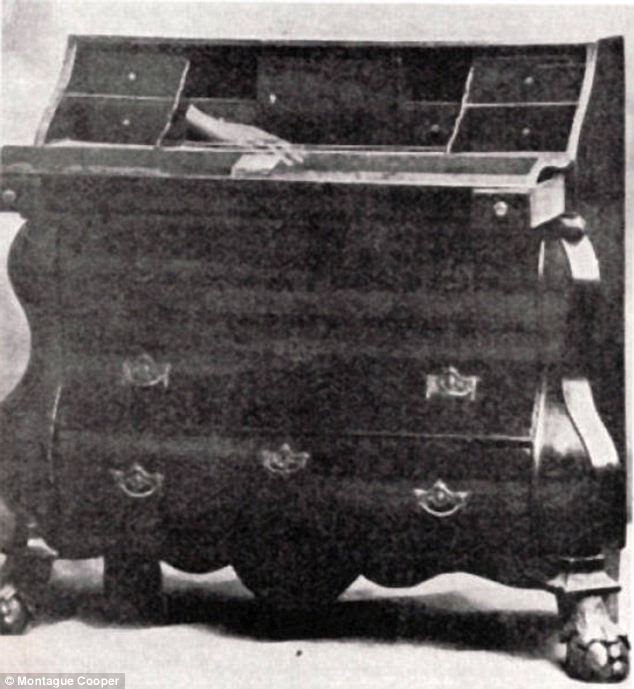
This early 20th century snap of a bureau was taken at the request of a furniture dealer by Montague Cooper, a well-respected photographer of the day. It appears he was so good, even a ghost wanted to pose for him
A child ghost haunting the attic takes fancy to the dolls of my wife
An orb manifest a demon on a table which is constructed with cloven feet. Subsequently, we disposed this beautiful table set at a great loss. Underneath this floor, is a two story high cellar.
“There’s no such thing as a curse. That’s just a goofy fortune-teller’s way of getting money.”
“What parapsychologists refer to as a ‘haunting’ is like what you and I would think of as a recording. Residual energy is trapped in whatever object it is, and it replays itself. There’s nothing intelligent about it. It just plays the same thing over and over. Then, sometimes, you can have objects that actually have what people would assume to be a spirit attached to them, which has some intelligence. So that would be like if you were dead and you decided you wanted to hang out with your favorite dress or your favorite chair. I still call it an ‘energy’ because I don’t know that what we experience paranormally is necessarily the ghost of a dead person.”
In addition, some people may be able to “read” objects that are not haunted at all, Frazier says. “That’s actually a form of psychic work that people do called ‘psychometry,’ where you hold an object and you read off of it,” she explains. “A lot of people mistake that for an object being haunted. For example, I used to have an antique piano, a 100 years old or older, in my house. When I would sit down and play it, I would see flashes of the people who had played this piano before me, and where they lived. It’s not necessarily that there’s anything active going on with the piano, but I’m touching that object and somehow I’m reading the energy of that.”
The family in this supposedly haunted 1880s tintype photo album is said to have burned to death in a fire.
On his FAQ at the Museum of the Paranormal, Zaffis agrees that such phenomena are all about energy, but he has a different theory about how the energy got there. “With most of the items in the museum, they have been used in rituals, usually when spells are being cast,” he writes. “Although the items are not ‘possessed,’ … items can hold energy within or around them, and it is usually the result of the energy being sent to the object by an individual.”
Browne, the psychic, says that it’s more likely that an item holds negative energy because something traumatic happened around the object, or someone was killed with the object in their possession. “There’s no such thing as a curse,” Browne says. “That’s just a goofy fortune-teller’s way of getting money.”
However, Browne does believe that you have to be careful when you’re in an antiques store. The key, she says, is to touch things and see if they’re unnaturally cold or if they give off a bad vibe. “I know this woman who bought an antique ring, and when she put it on, she got sick,” Browne says. “She was sick until she took it off. I told her, ‘Just give it away,’ because she was unusually sensitive to its energy.”
The maker of these “demon rings” claims to be a practitioner of black magic who has imbued them with spirits known as “djinns,” or genies.
But Shermer, the skeptic, says the idea of an antique holding energy, or “recording” an event, is scientifically impossible. “An object cannot record some additional curse or spirit or energy in it unless it actually has like a memory hard drive inside of it,” he says. “But other than that, ‘haunted’ whatever—hats, articles of clothing, watches, or jewelry—can’t carry any such thing.”
Paranormal investigators are well aware of these criticisms from the scientific community. To give their work legitimacy, they often use scientific tools such as electromagnetic field (EMF) meters, thermometers, thermal imaging, motion detectors, cameras, and compasses to try document physical proof of ghosts. On his Paranormal Network blog, noted parapsychologist Loyd Auerbach, however, asserts that these experiences might not be measurable because they are psychic events. His position is strangely similar to the Skeptics Society, except that Auerbach believes paranormal forces can affect your brain. an antique item may be haunted if these situations come into play
The person who previously owned the piece has not yet crossed over AND they have a strong emotional or spiritual attachment to the item.
However, all items, antique or new, do have the potential to have residual energy attached to them - which is why I recommend releasing this energy through a saging or smudging ritual. how do you know if an antique item is haunted?
Unfortunately, it’s very hard to tell if an antique piece is haunted until after you bring it home.
There are so many Spirits present in most antique stores, that it can be really difficult to pinpoint who is attached to what, until after you walk out of the store and single out the piece in question.
Thankfully, if you’ve brought a piece home and you think it may be haunted, there are a few things you can do.
Above the attic of my house in France haunted by orbs. It does seem that there is a conscious mind behind the orbs. By looking more closely into the spirit orbs sometimes there does appear to be faces.
A child haunting the attik takes fancy to the dolls of my wife
Papa’s Soul, I took this picture by accident after his funeral Services. After magnifying that small orb, a likeness of my father appeared. He as a younger man with glasses on and a whole crop of hair.











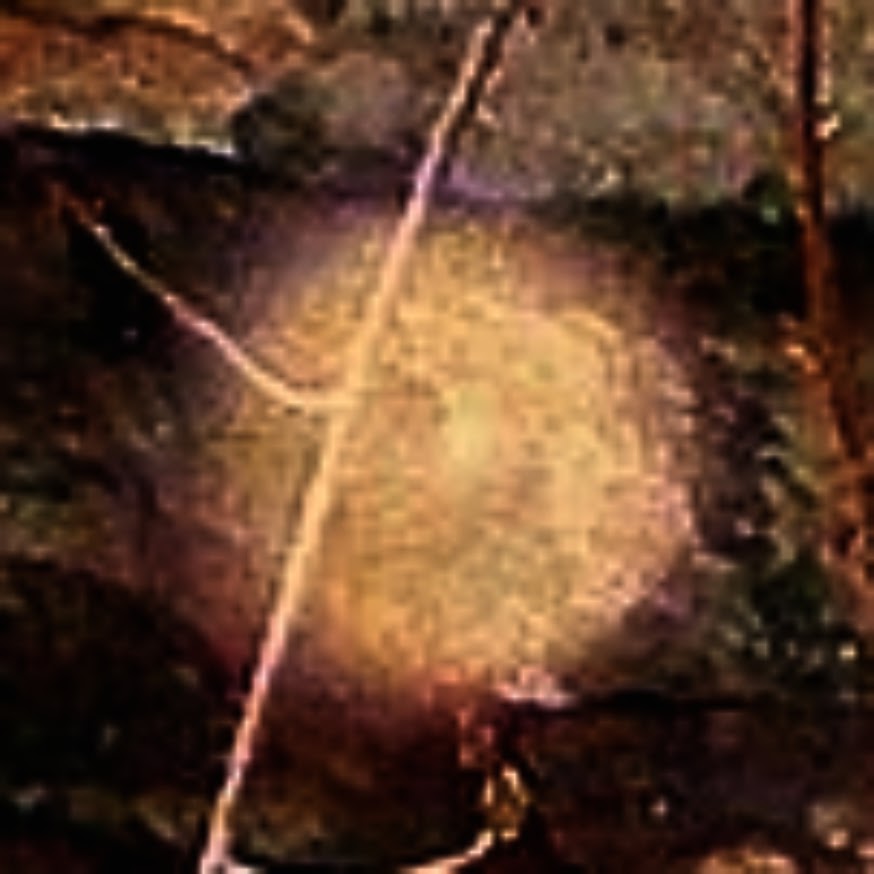








 Although they are often around during times of celebration, don’t be surprised if you see orbs in simple photos at home of the children or grandchildren playing. They will also often show up in those photos, as they are visiting and interacting with the children. Don’t be surprised either, if the child or young children seem to be interacting with someone in the photos! Younger children have not yet been deprogrammed and are often much more aware of their presence that the adults in the environment. (unless of course the adults are empaths or mediums!)