
  Beynac
The Fool is a powerful Tarot card because its possibilities all start in nothingness and reach into infinity
On Friday October 13, 1307 the French King Philip IV, who was deeply indebted to the Knights Templar, ordered them arrested and charged with heretical practices and on November 22 of that year under pressure from Philip, Pope Clement V issued the papal bull Pastoralis Praeeminentiae instructing all the monarchs of Europe to seize their assets.
Whether or not the Knights Templar practiced heretical beliefs as charged, the immolation of Templar Grand Master Jacques de Molay at the hands of the Pope’s Inquisitors in 1314 would serve as an inspiration to generations of people who did.
Pope Innocent III’s brutal Albigensian Crusade of 1209-29 against the powerful dualist Cathar movement pitted Northern France’s Catholic nobility against the lesser nobility of the south who were tolerant and supportive of it.
As a pre-Christian faith deeply rooted in the ancient world and spread by Rome’s legions through Mithraism to the four corners of the pagan Roman Empire, Catharism represented an old and powerful belief system which refused to be suppressed by the sterile and often contradictory doctrines of Rome’s Christian Empire.
As described by Reverend V.A. Demant, Canon of London’s St. Paul’s Cathedral in a preface to a 1947 book on the subject titled The Arrow and the Sword:

Persian god, Mithra
“To mention only its roots in Mithraism, its links with the Gnostics, its theological dualism, its asceticism, the ritual of life and death as cosmic mysteries, the appeal of the troubadours, Arthurian legends and the cult of the Holy Grail, the passions aroused for and against witchcraft, the intimate connection between sex and religion — all these things are sufficient testimony to the deep rooted vitality of a stream of religious consciousness which cannot be superciliously dismissed by rationalists and moralists.”
Writing on the heels of World War II, and with Europe still in ruins from the rise of an irrational and immoral pagan faith called Nazism, Demant feared that such a vital apocalyptic belief system with its “robust religiousness” and commitment to a struggle against an evil material world was bound to rise again, as it had so many times in the past.
Yet, he might not have been surprised to know that his own “Protestant” faith, of which he was a senior officer as the Canon of St. Paul’s, had its own roots in the same heresy.
Now lost in the cross weaves of history, Britain’s version of the heresy represented a new and far more dangerous version of life-denying Catharism than was ever imagined by the Templars, Bernard of Clairvaux or Jacques DeMolay.
|   |
|
The Third Crusade
Part of the Crusades
Date 1189–1192
ResultTreaty of Ramla. Jerusalem remains under Muslim control. Crusader military victory. Italians consolidate control of Syrian ports. Muslims allow trade and unarmed Christian pilgrimages into the Holy Land.
Territorial
changes Cyprus, Acre, Jaffa, and much of the Levantine coast are annexed under Crusader control.
Belligerents
Crusader battles in the Levant (1096–1303). The Third Crusade (1189–1192), also known as the Kings' Crusade, was an attempt by European leaders to reconquer the Holy Land from Saladin (Ṣalāḥ ad-Dīn Yūsuf ibn Ayyūb). It was largely successful, but fell short of its ultimate goal—the reconquest of Jerusalem.
After the failure of the Second Crusade, the Zengid dynasty controlled a unified Syria and engaged in a conflict with the Fatimid rulers of Egypt, which ultimately resulted in the unification of Egyptian and Syrian forces under the command of Saladin, who employed them to reduce the Christian states and to recapture Jerusalem in 1187. Spurred by religious zeal, Henry II of England and Philip II of France ended their conflict with each other to lead a new crusade (although Henry's death in 1189 put the English contingent under the command of Richard Lionheart instead). The elderly Holy Roman Emperor Frederick Barbarossa responded to the call to arms, and led a massive army across Anatolia, but drowned in a river in Asia Minor on June 10, 1190, before reachingthe Holy Land. His death caused the greatest grief among the German Crusaders. Most of his discouraged troops left to go home.
After driving the Muslims from Acre, Frederick's successor Leopold V of Austria and Philip left the Holy Land in August 1191. Saladin failed to defeat Richard in any military engagements, and Richard secured several more key coastal cities. Nevertheless, on September 2, 1192, Richard finalized a treaty with Saladin by which Jerusalem would remain under Muslim control, but which also allowed unarmed Christian pilgrims and merchants to visit the city. Richard departed the Holy Land on October 9. The successes of the Third Crusade would allow the Crusaders to maintain a considerable kingdom based in Cyprus and the Syrian coast. However, its failure to recapture Jerusalem would lead to the call for a Fourth Crusade six years later.
]Muslim unification
After the failure of the Second Crusade, Nur ad-Din Zangi had control of Damascus and a unified Syria.
Eager to expand his power, Nur ad-Din set his sights on the Fatimid dynasty of Egypt. In 1163, Nur ad-Din's most trusted general, Shirkuh set out on a military expedition to the Nile. Accompanying the general was his young nephew, Saladin.

With Shirkuh's troops camped outside of Cairo, Egypt's sultan, Shawar called on King Amalric I of Jerusalem for assistance. In response, Amalric sent an army into Egypt and attacked Shirkuh's troops at Bilbeis in 1164.
In an attempt to divert Crusader attention from Egypt, Nur ad-Din attacked Antioch, resulting in a massacre of Christian soldiers and the capture of several Crusader leaders, including Bohemond III, Prince of Antioch. Nur ad-Din sent the scalps of the Christian defenders to Egypt for Shirkuh to proudly display at Bilbeis for Amalric's soldiers to see. This action prompted both Amalric and Shirkuh to lead their armies out of Egypt.
In 1167, Nur ad-Din once again sent Shirkuh to conquer the Fatimids in Egypt. Shawar also opted to once again call upon Amalric for the defence of his territory. The combined Egyptian-Christian forces pursued Shirkuh until he retreated to Alexandria.
Amalric then breached his alliance with Shawar by turning his forces on Egypt and besieging the city of Bilbeis. Shawar pleaded with his former enemy, Nur ad-Din to save him from Amalric's treachery. Lacking the resources to maintain a prolonged siege of Cairo against the combined forces of Nur ad-Din and Shawar, Amalric retreated. This new alliance gave Nur ad-Din rule over virtually all of Syria and Egypt.
 Saladin's conquests
Shawar was executed for his alliances with the Christian forces, and Shirkuh succeeded him as vizier of Egypt. In 1169, Shirkuh died unexpectedly after only weeks of rule. Shirkuh's successor was his nephew, Salah ad-Din Yusuf, commonly known as Saladin. Nur ad-Din died in 1174, leaving the new empire to his 11-year old son, As-Salih. It was decided that the only man competent enough to uphold the jihad against the Franks was Saladin, who became sultan of both Egypt and Syria, and the founder of the Ayyubid dynasty.
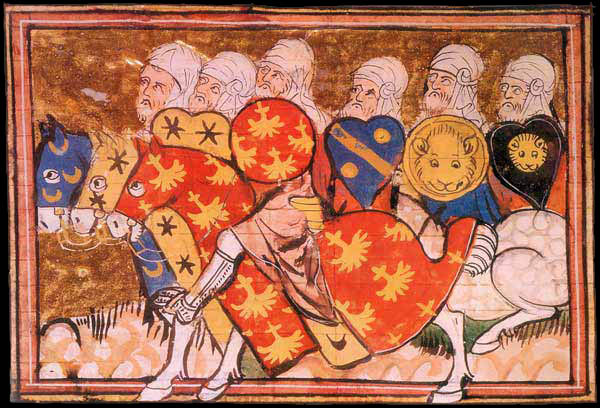
Amalric also died in 1174, leaving Jerusalem to his 13-year old son, Baldwin IV. Although Baldwin suffered from leprosy, he was an effective and active military commander, defeating Saladin at the battle of Montgisard in 1177, with support from Raynald of Châtillon, who had been released from prison in 1176. Later, he forged an agreement with Saladin to allow free trade between Muslim and Christian territories.
Raynald also raided caravans throughout the region. He expanded his piracy to the Red Sea by sending galleys not only to raid ships, but to assault the city of Mecca itself. These acts enraged the Muslim world, giving Raynald a reputation as the most hated man in the Middle East.
Baldwin IV died in 1185 and the kingdom was left to his nephew Baldwin V, whom he had crowned as co-king in 1183. Raymond III of Tripoli again served as regent. The following year, Baldwin V died before his ninth birthday, and his mother Princess Sybilla, sister of Baldwin IV, crowned herself queen and her husband, Guy of Lusignan, king.
It was at this time that Raynald, once again, raided a rich caravan and had its travelers thrown in prison. Saladin demanded that the prisoners and their cargo be released. The newly crowned King Guy appealed to Raynald to give in to Saladin's demands, but Raynald refused to follow the king's orders.

The Near East, c. 1190, at the outset of the Third Crusade.
[edit]Siege of the Kingdom of Jerusalem
It was this final act of outrage by Raynald which gave Saladin the opportunity he needed to take the offensive against the kingdom. He laid siege to the city of Tiberias in 1187. Raymond advised patience, but King Guy, acting on advice from Raynald, marched his army to the Horns of Hattin outside of Tiberias.
The Frankish army, thirsty and demoralized, was destroyed in the ensuing battle. King Guy and Raynald were brought to Saladin's tent, where Guy was offered a goblet of water because of his great thirst . Guy took a drink and then passed the goblet to Raynald. Saladin would not be forced to protect the treacherous Raynald by allowing him to drink, as it was custom that if you were offered a drink, your life was safe. When Raynald accepted the drink, Saladin told his interpreter, "say to the King: 'it is you who have given him to drink'". Afterwards, Saladin beheaded Raynald for past betrayals. Saladin honored tradition with King Guy; Guy was sent to Damascus and eventually ransomed to his people, one of the few captive crusaders to avoid execution.
By the end of the year, Saladin had taken Acre and Jerusalem. Pope Urban III is said to have collapsed and died upon hearing the news. However, at the time of his death, the news of the fall of Jerusalem could not yet have reached him, although he knew of the battle of Hattin and the fall of Acre.
 Preparations
The new pope, Gregory VIII proclaimed that the capture of Jerusalem was punishment for the sins of Christians across Europe. The cry went up for a new crusade to the Holy Land. Henry II of England and Philip II of France ended their war with each other, and both imposed a "Saladin tithe" on their citizens to finance the venture. In Britain, Baldwin of Exeter, the archbishop of Canterbury, made a tour through Wales, convincing 3,000 men-at-arms to take up the cross, recorded in the Itinerary of Giraldus Cambrensis.

"Death of Frederick of Germany" by Gustav Dore
Barbarossa's crusade
The elderly Holy Roman Emperor Frederick I Barbarossa responded to the call immediately. He took up the Cross at Mainz Cathedral on March 27, 1188 and was the first to set out for the Holy Land in May 1189 with an army of about 100,000 men, including 20,000 knights. An army of 2,000 men from the Hungarian prince Géza, the younger brother of the king Béla III of Hungary also went with Barbarossa to the Holy Land.
The Byzantine Emperor Isaac II Angelus made a secret alliance with Saladin to impede Frederick's progress in exchange for his empire's safety. Meanwhile, the Sultanate of Rum promised Frederick safety through Anatolia, but after much raiding Frederick lost patience and on May 18, 1190, the German army sacked Iconium, the capital of the Sultanate of Rüm. Nevertheless Frederick's horse slipped on June 10, 1190, while crossing the Saleph River throwing him against the rocks. He then drowned in the river. After this, much of his army returned to Germany, in anticipation of the upcoming Imperial election. His son Frederick of Swabia led the remaining 5,000 men to Antioch. There, the emperor's body was boiled to remove the flesh, which was interred in the Church of St. Peter; his bones were put in a bag to continue the crusade. In Antioch, however, the German army was further reduced by fever. Young Frederick had to ask the assistance of his kinsman Conrad of Montferrat to lead him safely to Acre, by way of Tyre, where his father's bones were buried.
Richard and Philip's departure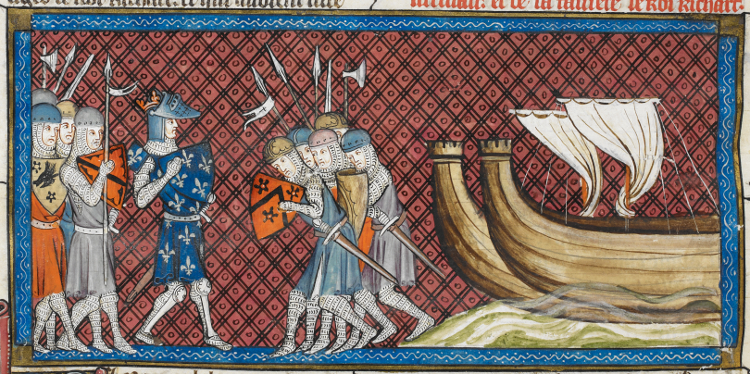
Philip II depicted arriving in Palestine
Henry II of England died on July 6, 1189 following a defeat by his son Richard I (Lionheart) and Philip II. Richard inherited the crown and immediately began raising funds for the crusade. In July 1190, Richard and Philip set out jointly from Marseille, France for Sicily. Philip II had hired a Genoese fleet to transport his army which consisted of 650 knights, 1,300 horses, and 1,300 squires to the Holy Land.
William II of Sicily had died the previous year, and was replaced by Tancred, who placed Joan of England—William's wife and Richard's sister—in prison. Richard captured the capital city of Messina on October 4, 1190 and Joan was released. Richard and Philip fell out over the issue of Richard's marriage, as Richard had decided to marry Berengaria of Navarre, breaking off his long-standing betrothal to Philip's half-sister Alys. Philip left Sicily directly for the Middle East on March 30, 1191, and arrived in Tyre in mid-May. He joined the siege of Acre on May 20. Richard did not set off from Sicily until April 10.
Shortly after setting sail from Sicily, Richard's armada of 100 ships (carrying 8,000 men) was struck by a violent storm. Several ships ran aground, including one holding Joan, his new fiancée Berengaria, and a large amount of treasure that had been amassed for the crusade. It was soon discovered that Isaac Dukas Comnenus of Cyprus had seized the treasure. The young women were unharmed. Richard entered Limassol on May 6, and met with Isaac, who agreed to return Richard's belongings and send 500 of his soldiers to the Holy Land. Once back at his fortress of Famagusta, Isaac broke his oath of hospitality and began issuing orders for Richard to leave the island. Isaac's arrogance prompted Richard to conquer the island within days.
Siege of Acre
King Guy was released from prison by Saladin in 1189. He attempted to take command of the Christian forces at Tyre, but Conrad of Montferrat held power there after his successful defense of the city from Muslim attacks. Guy turned his attention to the wealthy port of Acre. He amassed an army to besiege the city and received aid from Philip's newly arrived French army. However, it was still not enough to counter Saladin's force, which besieged the besiegers. In summer 1190, in one of the numerous outbreaks of disease in the camp, Queen Sibylla and her young daughters died. Guy, although only king by right of marriage, endeavored to retain his crown, although the rightful heir was Sibylla's half-sister Isabella. After a hastily arranged divorce from Humphrey IV of Toron, Isabella was married to Conrad of Montferrat, who claimed the kingship in her name.
During the winter of 1190–91, there were further outbreaks of dysentery and fever, which claimed the lives of Frederick of Swabia, Patriarch Heraclius of Jerusalem, and Theobald V of Blois. When the sailing season began again in spring 1191, Leopold V of Austria arrived and took command of what remained of the imperial forces. Philip of France arrived with his troops from Sicily in May.
Richard arrived at Acre on June 8, 1191 and immediately began supervising the construction of siege weapons to assault the city. The city was captured on July 12.
Richard, Philip, and Leopold quarreled over the spoils of their victory. Richard cast down the German standard from the city, slighting Leopold. Also, in the struggle for the kingship of Jerusalem, Richard supported Guy, while Philip and Leopold supported Conrad, who was related to them both. It was decided that Guy would continue to rule, but that Conrad would receive the crown upon his death.
Frustrated with Richard (and in Philip's case, in poor health), Philip and Leopold took their armies and left the Holy Land in August. Philip left 10,000 French crusaders in the Holy Land and 5,000 silver marks to pay them.
Saladin tried to negotiate with Richard for the release of the captured Muslim soldier garrison, which included their women and children, but on August 20, Richard thought that Saladin had delayed too much, and had 2,700 of the Muslim prisoners decapitated in full view of Saladin's army, who tried unsuccessfully to rescue them. Saladin then responded by killing all of the Christian prisoners he had captured.
Battle of Arsuf
After the capture of Acre, Richard decided to march to the city of Jaffa, where he could launch the attack on Jerusalem but on September 7, 1191, at Arsuf, 30 miles (50 km) north of Jaffa, Saladin attacked Richard's army.
Saladin attempted to lure Richard's forces out to be easily picked off, but Richard maintained his formation until the Hospitallers rushed in to take Saladin's right flank, while the Templars took the left. Richard then won the battle.
Regicide and negotiations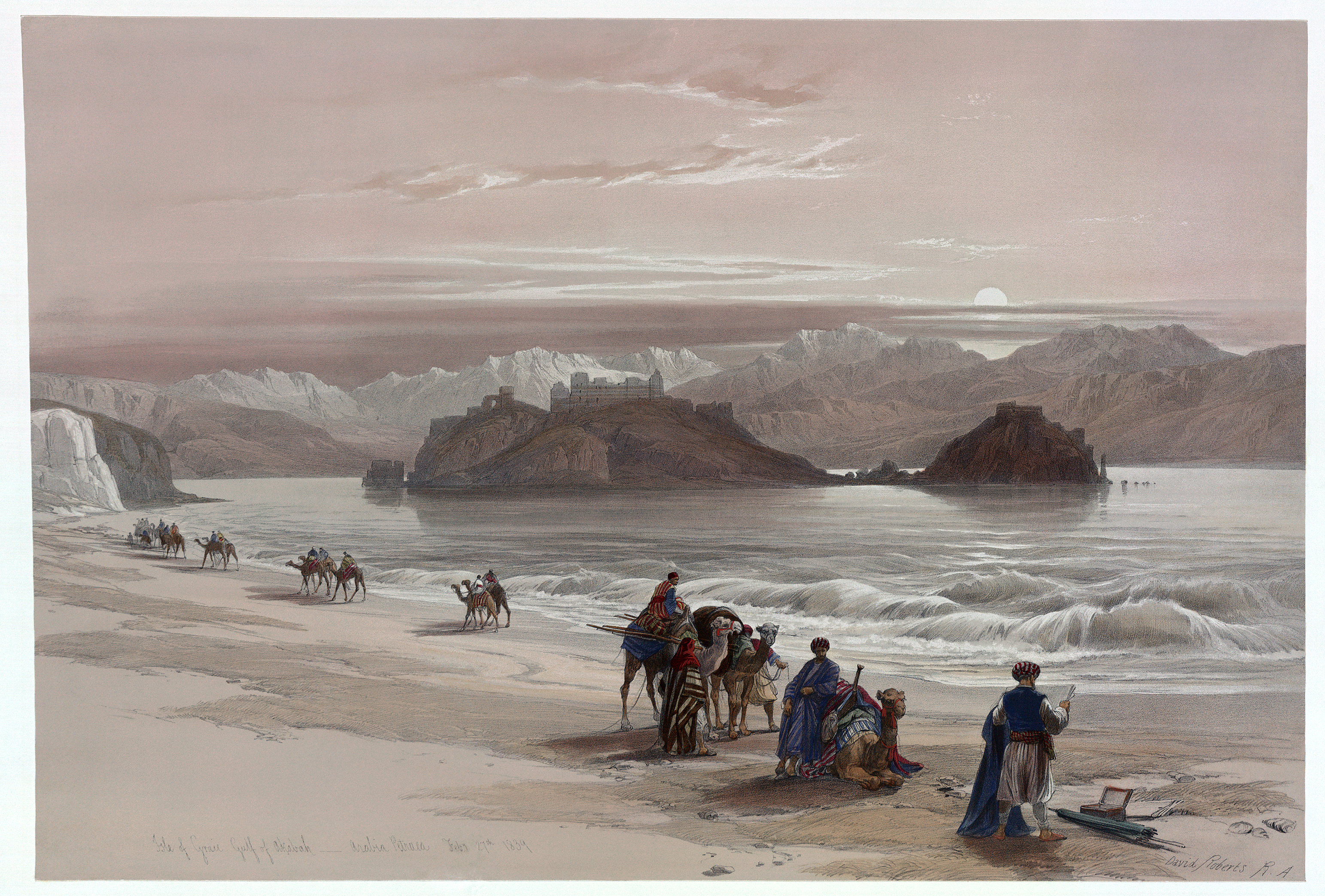
Saladin and Richard assured the rights and protection of pilgrim and caravan routes that allowed travel to distant lands.
Following his victory, Richard took Jaffa and established his new headquarters there. He offered to begin negotiations with Saladin, who sent his brother, Al-Adil to meet with Richard. Negotiations (which had included an attempt to marry Richard's sister Joan to Al-Adil) failed, and Richard marched to Ascalon. Richard's forces were halted nearly 12 times by the forces of Saladin commanded by Ayaz al-Tawil a powerful Mamluk leader, who died in combat.
Richard called on Conrad to join him on campaign, but he refused, citing Richard's alliance with King Guy. He too had been negotiating with Saladin, as a defense against any attempt by Richard to wrest Tyre from him for Guy. However, in April, Richard was forced to accept Conrad as king of Jerusalem after an election by the nobles of the kingdom. Guy had received no votes at all, but Richard sold him Cyprus as compensation. Before he could be crowned, Conrad was stabbed to death by two assassins in the streets of Tyre. Eight days later, Richard's nephew Henry II of Champagne married Queen Isabella, who was pregnant with Conrad's child. It was strongly suspected that the king's killers had acted on instructions from Richard.
In July 1192, Saladin's army suddenly attacked and captured Jaffa with thousands of men, but Saladin had lost control of his army because of their anger for the massacre at Acre. It was believed that Saladin even told the Crusaders to shield themselves in the Citadel until he had regained control of his army. Richard was intending to return to England when he heard the news that Saladin and his army had captured Jaffa. Richard and a small force of 2000 men went to Jaffa by sea in a surprise attack. In the subsequent Battle of Jaffa (1192), the Ayyubids, being unprepared for a naval attack were overwhelmed. Richard then retook Jaffa and freed the Crusader prisoners, who proceeded to join his force. However, Saladin's forces still had numerical superiority and counter-attacked. Saladin intended a stealth and surprise attack at dawn, but his forces were discovered. Saladin still attacked though, but his men were lightly armored and suffered very heavy casualties due to the Crusader archers. The battle to retake Jaffa ended in complete failure for Saladin who was forced to retreat. This battle greatly strengthened the position of the coastal Crusader states.
On September 2, 1192, following his defeat at Jaffa, Saladin was forced to finalized a treaty with Richard by which Jerusalem would remain under Muslim control, but which also allowed unarmed Christianpilgrims and traders to visit the city. Richard departed the Holy Land on October 9, 1192.
Aftermath
The Levant after the Third Crusade in 1200.
Neither side was entirely discontent nor satisfied with the results of the war. Though Richard had deprived the Muslims of important coastal territories as a result of his consistent victories over Saladin, many Christians in the Latin West felt disappointed that he had elected not to pursue Jerusalem. Likewise, many in the Islamic world felt disturbed that Saladin had failed to drive the Christians out of Syria and Palestine. Trade, however, flourished throughout the Middle East and in port cities along the Mediterranean coastline.
Saladin's servant and biographer Baha al-Din recounted Saladin's distress at the successes of the Crusaders:
Richard was arrested and imprisoned in December 1192 by Duke Leopold, who suspected him of murdering his cousin Conrad of Montferrat, and had been offended by Richard casting down his standard from the walls of Acre. He was later transferred to the custody of Henry VI, Holy Roman Emperor, and it took a ransom of one hundred and fifty thousand marks to obtain his release. Richard returned to England in 1194 and died of a crossbow bolt wound in 1199 at the age of 41.
In 1193, Saladin died of yellow fever. His heirs would quarrel over the succession and ultimately fragment his conquests.
Henry of Champagne was killed in an accidental fall in 1197. Queen Isabella then married for a fourth time, to Amalric of Lusignan, who had succeeded his brother Guy, positioned as King of Cyprus. After their deaths in 1205, her eldest daughter Maria of Montferrat (born after her father's murder) succeeded to the throne of Jerusalem.
Richard's decision not to attack Jerusalem would lead to the call for a Fourth Crusade six years after the third ended in 1192. However, Richard's victories facilitated the survival of a wealthy Crusader kingdom centered on Acre. Historian Thomas Madden summarizes the achievements of the Third Crusade:
Accounts of events surrounding the Third Crusade were written by the anonymous authors of the Itinerarium Peregrinorum et Gesta Regis Ricardi (a.k.a. the Itinerarium Regis Ricardi), the Old French Continuation of William of Tyre (parts of which are attributed to Ernoul), and by Ambroise, Roger of Howden, Ralph of Diceto, and Giraldus Cambrensis.
|  " Lionheart"
Richard the Lionheart
King of England (more..) Reign 6 July 1189 – 6 April 1199 Coronation 3 September 1189 Predecessor Henry II Successor John Regent Eleanor of Aquitaine; William Longchamp (Third Crusade) Consort Berengaria of Navarre Issue Philip of Cognac House House of Plantagenet Father Henry II of England Mother Eleanor of Aquitaine Born 8 September 1157(1157-09-08) Beaumont Palace, Oxford Died 6 April 1199(1199-04-06) (aged 41) Châlus, Limousin Burial Fontevraud Abbey, France
Richard I (8 September 1157 – 6 April 1199) was King of England from 6 July 1189 until his death. He also ruled as Duke of Normandy, Duke of Aquitaine, Duke of Gascony, Lord of Cyprus, Count of Anjou, Count of Maine, Count of Nantes, and Overlord of Brittany at various times during the same period. He was known as Cœur de Lion, or Richard the Lionheart, even before his accession, because of his reputation as a great military leader and warrior.[1] The Saracens called him Melek-Ric or Malek al-Inkitar - King of England.[2]
By the age of sixteen Richard was commanding his own army, putting down rebellions in Poitou against his father, King Henry II.[1] Richard was a central Christian commander during the Third Crusade, effectively leading the campaign after the departure of Philip Augustus and scoring considerable victories against his Muslim counterpart, Saladin, but was unable to reconquer Jerusalem.[3]
Although speaking only French and spending very little time in England (he lived in his Duchy of Aquitaine in the southwest of France, preferring to use his kingdom as a source of revenue to support his armies),[4] he was seen as a pious hero by his subjects.[5] He remains one of the very few Kings of England remembered by his epithet, rather than regnal number, and is an enduring, iconic figure in England.
  Tel Megiddo, entry gate
Known under its Greek name Armageddon.
Megiddo was a site of great importance in the ancient world, as it guarded the western branch of a narrow pass and an ancient trade route which connected the lands of Egypt and Assyria. Because of its strategic location at the crossroads of several major routes, Megiddo and its environs have witnessed several major battles throughout history. The site was inhabited from approximately 7000 BC to 586 BC (the same time as the destruction of the First Israelite Temple in Jerusalem by the Babylonians, and subsequent fall of Israelite rule and exile). One of its claims to importance is the fact that since this time it has remained uninhabited, thereby preserving the ruins of its time periods pre-dating 586 BC without newer settlements disturbing them.
Megiddo is mentioned in Ancient Egyptian writings because one of Egypt's mighty kings, Thutmose III, waged war upon the city in 1478 BC. The battle is described in detail in the hieroglyphics found on the walls of his temple in Upper Egypt. Named in the Bible Derekh HaYam (Hebrew: דרך הים), or "Way of the Sea," it became an important military artery of the Roman Empire and was known as the Via Maris.
In 2005, the remains of Megiddo were designated a World Heritage Site by UNESCO as part of the Biblical Tels - Megiddo, Hazor, Beer Sheba.
 Tel Megiddo, ruins on the citadell
Known under its Greek name Armageddon.
Megiddo was a site of great importance in the ancient world, as it guarded the western branch of a narrow pass and an ancient trade route which connected the lands of Egypt and Assyria. Because of its strategic location at the crossroads of several major routes, Megiddo and its environs have witnessed several major battles throughout history. The site was inhabited from approximately 7000 BC to 586 BC (the same time as the destruction of the First Israelite Temple in Jerusalem by the Babylonians, and subsequent fall of Israelite rule and exile). One of its claims to importance is the fact that since this time it has remained uninhabited, thereby preserving the ruins of its time periods pre-dating 586 BC without newer settlements disturbing them.
Megiddo is mentioned in Ancient Egyptian writings because one of Egypt's mighty kings, Thutmose III, waged war upon the city in 1478 BC. The battle is described in detail in the hieroglyphics found on the walls of his temple in Upper Egypt. Named in the Bible Derekh HaYam (Hebrew: דרך הים), or "Way of the Sea," it became an important military artery of the Roman Empire and was known as the Via Maris.
 Tel Megiddo, Biblical site
Known under its Greek name Armageddon.
Megiddo was a site of great importance in the ancient world, as it guarded the western branch of a narrow pass and an ancient trade route which connected the lands of Egypt and Assyria. Because of its strategic location at the crossroads of several major routes, Megiddo and its environs have witnessed several major battles throughout history. The site was inhabited from approximately 7000 BC to 586 BC (the same time as the destruction of the First Israelite Temple in Jerusalem by the Babylonians, and subsequent fall of Israelite rule and exile). One of its claims to importance is the fact that since this time it has remained uninhabited, thereby preserving the ruins of its time periods pre-dating 586 BC without newer settlements disturbing them.
Megiddo is mentioned in Ancient Egyptian writings because one of Egypt's mighty kings, Thutmose III, waged war upon the city in 1478 BC. The battle is described in detail in the hieroglyphics found on the walls of his temple in Upper Egypt. Named in the Bible Derekh HaYam (Hebrew: דרך הים), or "Way of the Sea," it became an important military artery of the Roman Empire and was known as the Via Maris.
 O Jerusalem : Mount Temple Explanada del Templo
Jerusalem, located in the Judean Mountains, between the Mediterranean Sea and the northern edge of the Dead Sea, is one of the oldest cities in the world and it is considered a holy city for three of the mayor monotheist religions: Judaism, Christianity and Islam. For such reason, in the course of its history, Jerusalem has been destroyed twice, besieged 23 times, attacked 52 times, and captured and recaptured 44 times. According to the majority opinion the name comes from the words “yeru” (house) and “shalom” (peace), i.e. “House of peace” (paradoxically).
It only has an area of 0.9 square kilometer (0.35 square mile), but the Old City has sites of key religious importance, such as the Temple Mount, the Western Wall, the Church of the Holy Sepulchre, the Dome of the Rock and al-Aqsa Mosque. Within the old city there are, 1204 synagogues, 158 churches, and 73 mosques. The old walled city, has been traditionally divided into four quarters, Armenian, Christian, Jewish, and Muslim. Actual walls were erected in 1538 by Suleiman and have 4,5 km, with 43 towers and 11 gates (only 7 opened). Jerusalem is the holiest city in Judaism and has been the spiritual center of the Jewish people since c. 1000 BCE, when David the King of Israel first established it as the capital of the Jewish Nation, and his son Solomon commissioned the building of the First Temple in the city, destroyed by Nebuchadnezzar, and then the site for the second temple, destroyed by Tito. The city is mentioned in the Bible 632 times. Today, the Western Wall, a remnant of the wall surrounding the Second Temple, is a Jewish holy site second only to the Holy of Holies on the Temple Christianity reveres Jerusalem for its significance in the life of Jesus. According to the New Testament, Jesus was brought to Jerusalem soon after his birth and later in his life cleansed the Second Temple. His mortal life finished at Golgotha, the site of the crucifixion. The land currently occupied by the Church of the Holy Sepulchre (erected by Constantine I) is considered one of the top candidates for Golgotha and thus has been a Christian pilgrimage site for the past two thousand years. Jerusalem is considered the third-holiest city in Islam, primarily due to Muhammad's Night of Ascension (c. AD 620). Muslims believe Muhammad was miraculously transported one night from Mecca to the Temple Mount in Jerusalem, whereupon he ascended to Heaven to meet previous prophets of Islam. Today, the Temple Mount is topped by two Islamic landmarks intended to commemorate the event—al-Aqsa Mosque (the fartherst … from Mecca), and the Dome of the Rock, from which Muslims believe Muhammad ascended to Heaven. In 1119, after the First Crusade, the French knight Hugues de Payens and his relative Godfrey de Saint-Omer, proposed the creation of a monastic order for the protection of pilgrims. King Baldwin II of Jerusalem agreed to their request, and gave them space for a headquarters on the Temple Mount, in the captured Al Aqsa Mosque, where it was believed to be the ruins of the Temple of Solomon. The Crusaders therefore referred to the Al Aqsa Mosque as Solomon's Temple, and it was from this location that the Order took the name of Poor Knights of Christ and the Temple of Solomon, or "Templar" knights. The Order, with nine knights, remained nine years within the Temple premises. After that period of time, the Order started growing and getting rich. What did the find? The rest is part of the history.  O Jerusalem Dome of the Rock La Cúpula de la Roca
Jerusalem, located in the Judean Mountains, between the Mediterranean Sea and the northern edge of the Dead Sea, is one of the oldest cities in the world and it is considered a holy city for three of the mayor monotheist religions: Judaism, Christianity and Islam. For such reason, in the course of its history, Jerusalem has been destroyed twice, besieged 23 times, attacked 52 times, and captured and recaptured 44 times. According to most opinions, the name comes from the words “yeru” (house) and “shalom” (peace), i.e. “House of peace” (paradoxically).
It only has an area of 0.9 square kilometer (0.35 square mile), but the Old City has sites of key religious importance, such as the Temple Mount, the Western Wall, the Church of the Holy Sepulchre, the Dome of the Rock and al-Aqsa Mosque. Within the old city there are, 1204 synagogues, 158 churches, and 73 mosques. The old walled city, has been traditionally divided into four quarters, Armenian, Christian, Jewish, and Muslim. Actual walls were erected in 1538 by Suleiman and have 4,5 km, with 43 towers and 11 gates (only 7 opened). Jerusalem is the holiest city in Judaism and has been the spiritual center of the Jewish people since c. 1000 BCE, when David the King of Israel first established it as the capital of the Jewish Nation, and his son Solomon commissioned the building of the First Temple in the city, destroyed by Nebuchadnezzar, and then the site for the second temple, destroyed by Titus. The city is mentioned in the Bible 632 times. Today, the Western Wall, a remnant of the wall surrounding the Second Temple, is a Jewish holy site second only to the Holy of Holies on the Temple Christianity reveres Jerusalem for its significance in the life of Jesus. According to the New Testament, Jesus was brought to Jerusalem soon after his birth and later in his life cleansed the Second Temple. His mortal life finished at Golgotha, the site of the crucifixion. The land currently occupied by the Church of the Holy Sepulchre (erected by Constantine I) is considered one of the top candidates for Golgotha and thus has been a Christian pilgrimage site for the past two thousand years. Jerusalem is considered the third-holiest city in Islam, primarily due to Muhammad's Night of Ascension (c. AD 620). Muslims believe Muhammad was miraculously transported one night from Mecca to the Temple Mount in Jerusalem, whereupon he ascended to Heaven to meet previous prophets of Islam. Today, the Temple Mount is topped by two Islamic landmarks intended to commemorate the event—al-Aqsa Mosque (the fartherst … from Mecca), and the Dome of the Rock, from which Muslims believe Muhammad ascended to Heaven. In 1119, after the First Crusade, the French knight Hugues de Payens and his relative Godfrey de Saint-Omer, proposed the creation of a monastic order for the protection of pilgrims. King Baldwin II of Jerusalem agreed to their request, and gave them space for a headquarters on the Temple Mount, in the captured Al Aqsa Mosque, where it was believed to be the ruins of the Temple of Solomon. The Crusaders therefore referred to the Al Aqsa Mosque as Solomon's Temple, and it was from this location that the Order took the name of Poor Knights of Christ and the Temple of Solomon, or "Templar" knights. The Order, with nine knights, remained nine years within the Temple premises. After that period of time, the Order started growing and getting rich. What did the find? The rest is part of the history. 
The heart of Richard I was buried in the Cathedral of Rouen, France, with mint, frankincense, mercury, creosote and daisies
Richard the Lionheart ended up with a heart full of daisies, mint and frankincense, a French study of his mummified heart has discovered.
The analysis also uncovered elements like creosote, mercury and perhaps lime in the heart, which has been in the western French city of Rouen since his death in 1199.
The study’s leader, Philippe Charlier, suggests the flowers and spices were to give the king the ‘odour of sanctity’.
The study came out less than a month after a team of British archeologists uncovered the long-lost remains of 15th-century King Richard III - a relative but not a direct descendant of Richard I - under a car park in Leicester.
Unlike that crude ending, Richard the Lionheart, leader of the Third Crusade, was ceremoniously laid to rest in three places.
His entrails were interred in the central French town of Chalus, where he died in a skirmish with a rebellious baron; his body reposes at the Fontevraud Abbey, beside his father Henry II and later his mother Eleanor of Aquitaine; and his heart, wrapped in linen, pickled for posterity and placed in a lead box, was sent on to the Cathedral of Rouen.
In 1838, the heart, already turned to powder, was rediscovered, transferred to a glass box and placed in Rouen’s Departmental Museum of Antiquities.
Charlier, a forensic medical examiner, and his 11-member team used the latest biomedical techniques to decipher the composition of The Lionheart’s heart.

Philippe Charlier, a forensic medical examiner, shows the remains of King Richard I's heart, which has undergone analysis more than 810 years after he died
RICHARD THE LIONHEART
Born on 8 September 1157 in Oxford, son of Henry II and Eleanor of Aquitaine, Richard I is one of the most popular kings in England history after leading the Third Christian Crusade against Muslims who had captured Jerusalem in the 12th century.
He failed to take the city because of inner-feuds between his Crusader allies, but scored numerous victories against Saladin, his Muslim counterpart.
Despite his reputation in England, Richard spent most of his time in his lands in France, and mainly conversed in French dialects.
Richard died after a crossbow bolt pierced his shoulder during a siege of the castle of Chalus-Chabrol in the Limousin region of France.
He claims it is the oldest embalmed heart ever studied and, belonging to a king, certainly the most prestigious.
The study was published in Scientific Reports, part of the Nature Publishing Group.
The aim of the study was to discover how hearts were embalmed in the 12th century, Charlier said. The presence of incense in the potpourri was the most striking because, Charlier said, it had not been found in previous embalmings, even in corpses dating from the Middle Ages.
Charlier speculates that the incense, among the gifts offered to the infant Jesus by the three kings and reportedly used on the outside of his body at death, was meant to give The Lionheart a direct line to God.
Richard I is one of the most popular kings in England history after leading the Third Christian Crusade against Muslims who had captured Jerusalem in the 12th century.
He failed to take the city because of inner-feuds between his Crusader allies, but scored numerous victories against Saladin, his Muslim counterpart.
Despite his reputation in England, Richard spent most of his time in his lands in France, and mainly conversed in French dialects.
Richard died after a crossbow bolt pierced his shoulder during a siege of the castle of Chalus-Chabrol in the Limousin region of France.
HOW TO PRESERVE A ROYAL HEART
Microscopic analysis showed pollen grains from daisy, myrtle and mint. lso found were pine, oak, poplar, plantain and bellflower, likely airborne contaminants. Poplar and bellflower were blooming at the time of death, the study says.
Molecular analysis turned up frankincense, the white matter in the powder.
There were large amounts of lead - said to be contamination from the box cradling the heart - and traces of copper and mercury, or quicksilver- commonly used at the time.
There is also a suggestion that lime may have been used as a disinfectant.
How bodies were preserved back then 'is a field of much speculation and, thus, such a study provides some decent evidence,' said Frank Ruhli, a professor at the University of Zurich's Center for Evolutionary Medicine.
However, he said in an email that the study has limited impact because of its focus on a single organ and on only one, if well-known, person

Philippe Charlier with the box which contained the heart, wrapped in linen, which was full of daisies, as well as myrtle, mint and frankincense.

This engraving by Huyot depicts the battle where King Richard I was killed by Bertrand de Gourdon at the siege of the castle of Chalus, France

Richard I's heart was wrapped in linen, pickled, and placed in a lead box for burial at the Cathedral of Rouen.
|

 Tomb of Richard the Lion Heart. Tomb of Richard the Lion Heart in Rouen cathedral. Richard was King of England freom 1157-1199.This tomb contains his heart. |   |


